
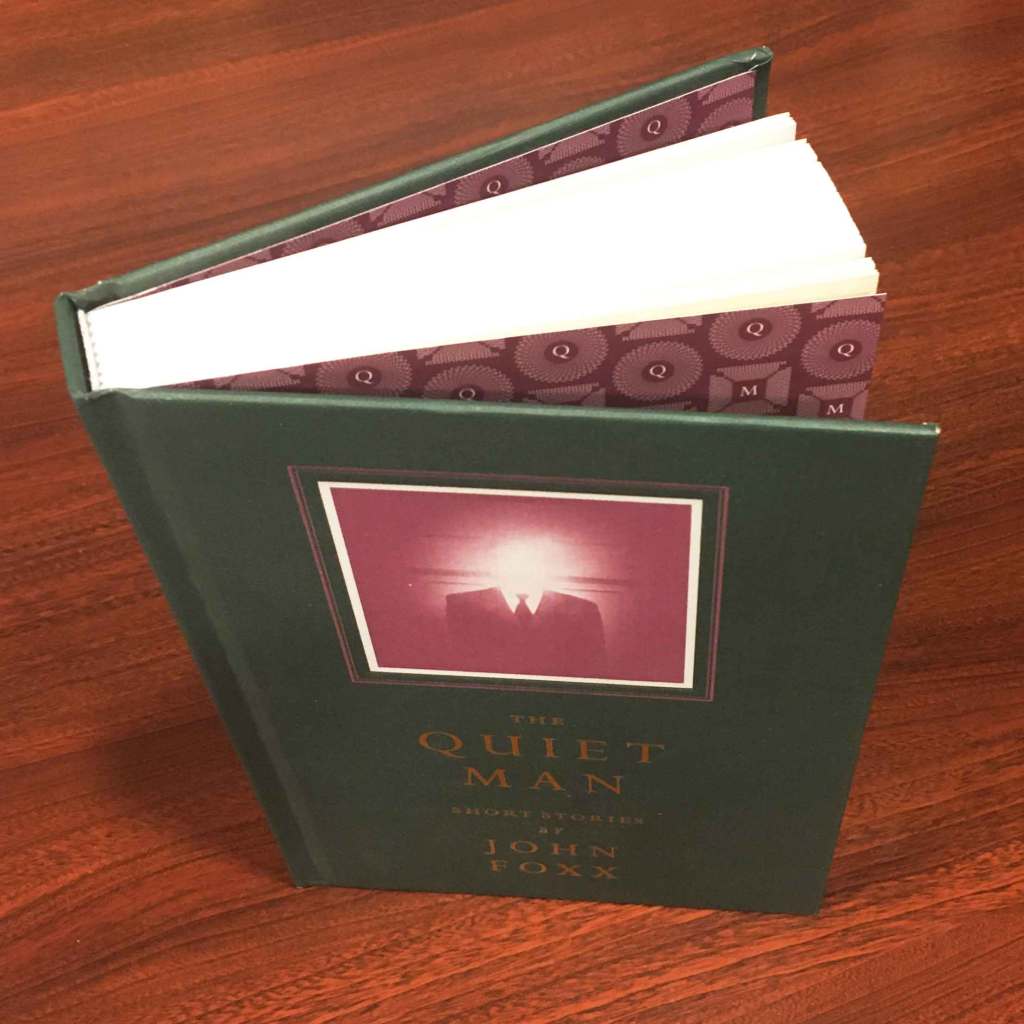
It seemed as if I had been waiting half a lifetime for the book of short stories written by John Foxx to flesh out thematic material for his songwriting. No sooner had I become a fan in early 1981, then I came across interviews with the artist claiming that he was concurrently writing “a book” which I soon came to expect, especially when excerpts from is were published in a booklet, “Church,” which accompanied his second album, “The Garden.” Before dismissing the notion that it would ever materialize by the time that his seeming retirement from music occurred in the mid eighties.
It wasn’t until I became a reader of Extreme Voice in the early 90s that I began corresponding with the people who ran the official Ultravox fanzine. Over the years that they still produced a print magazine, there would be occasional dips into Foxx’s binders for excerpts from “The Quiet Man” and it became abundantly clear that these short bursts of fiction; all redolent of the themes that Foxx brought to his music rendered on the page in concise, minimal prose as economical as the Technopop that he began his solo career with, were his laboratory of sorts.
Then came the announcement in 2019 that the book that never was would be published by Rocket 88 Books, and would in fact, be. I was confident that having seen the excerpts referenced earlier, the book would be more of the same; long passages of descriptive prose fascinated with Foxxian themes and peppered with turns of phrase that would inevitably be snatches of lyrics familiar from his large body of work. The intriguing thing was that I could not have been more off course.
While there were the very occasional lyrical phrase from his music career manifesting like bubbles of carbonation in the fluid of its makeup, those would be deviations from the norm. The book as finally been revealed as both a collection of short stories and a further cloud of story fragments; some of which were no longer than a SMS text. The book was divided in eleven chapters; each composed of a handful or more of discrete sub-sections which were self-contained storylines which could adhere to one another via thematic commonalities.
The bigger surprise here was the appearance of several pieces of speculative fiction that read like New Wave Science Fiction and could exhibit ties to that late 60s literary movement that not coincidentally flourished when Foxx was entering college in his formative years. Spinning fragments of everyday life touched by unusual, unexplained circumstances that in their own subtle ways, changed the lives of the protagonists in these tales.
Stories like “The Unfinished Boy” and “Under London” combine elements of the fantastic with the sort of prosaic, workaday detail that a young man growing up in postwar England would have burned into his DNA. Everyday life, drained of color and not dissimilar to the world inhabited by his parents. Portraits of keenly observed detail overlaid with the one element of strangeness. Forming a latticework upon which the writer could one day build an intriguing body of songs on. While some, such as the borderline abstract fantasy of “The Nebula” existed in their own hermetic world. Redolent of only pure imagination.
Most of the writing here employed the clipped, efficient prose that anyone with a copy of the “Church” booklet in “The Garden” would recognize. The writing spoke from the same sense of clinical detachment that Foxx brought to his “Metamatic” period of writing. Environments and emotions described with a minimum of fuss and little in the way of grandiloquence. In the few instances where sexuality appears it seemed off kilter, intruding into the ascetic world of these stories awkwardly in any way that was not purely metaphoric.
The fragmentary nature of so much here makes this a quick, but disconnected read if picked up on occasion. Making it better to read it in as large a chunk at a time as possible so that its gestalt can best wash over the reader and give them a sense of Foxx’s thematic interests, which can be mapped directly to that of his music. But it’s the stories that were apart from such concerns that carried the most heft and functioned as actual fiction instead of a notebook for songwriting. Coming from a primarily visual and music artist, “The Quiet Man” offered fascinating insights into the John Foxx we thought we all knew.
It seemed as if I had been waiting half a lifetime for the book of short stories written by John Foxx…and that’s because I had.
-30-






![Want List: Visage DLX RM […finally!]](https://i0.wp.com/postpunkmonk.com/wp-content/uploads/2018/11/visage-dlxrmuscda.jpeg?resize=200%2C200&ssl=1)


 Post-Punk Monk
Pingback: John Foxx Emerges From Den With Ambient Piano Album, “The Arcades Project” | Post-Punk Monk