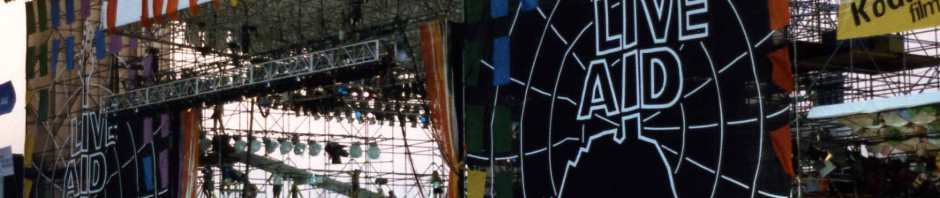
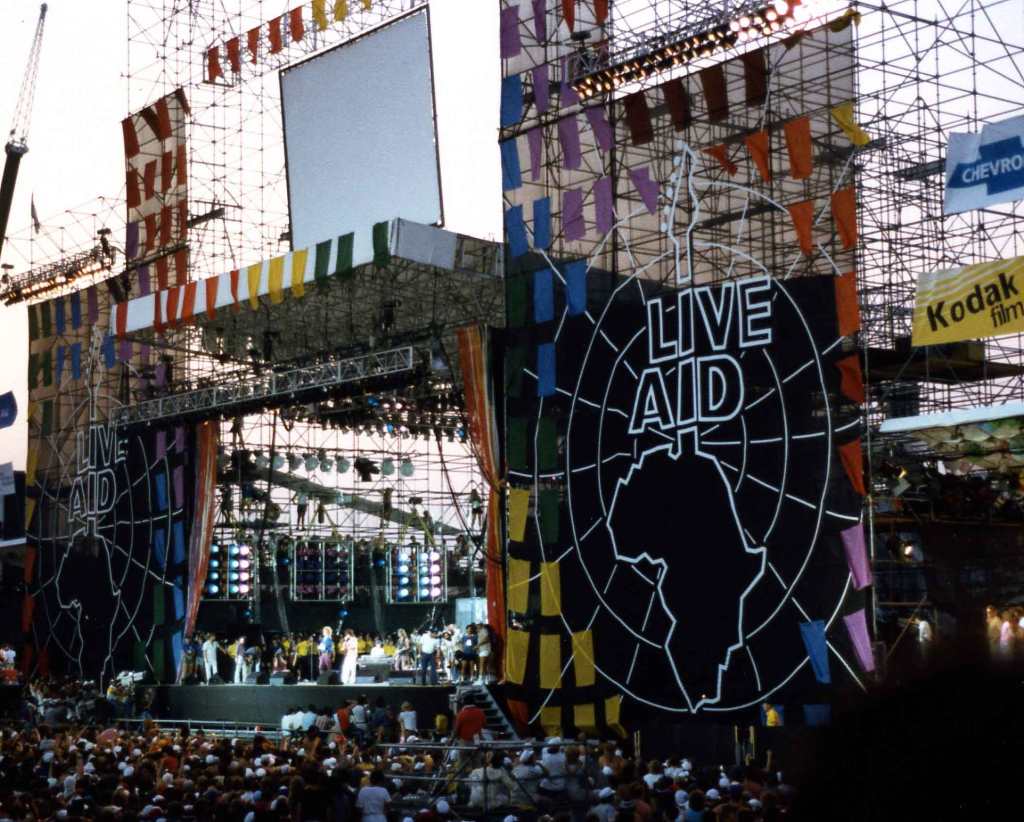
It’s hard to believe that the Live Aid phenomenon happened 40 decades ago. I was 21 years old and a music fanatic when it occurred, and I’m 61 years old now. More than a few of the artists playing at either Wembley Stadium in the UK or JFK Stadium in Philadelphia have departed from this mortal coil. But the event was not really all that and more to my young eyes. It seemed to mark the point where the artists who had previously dominated Rock and by extension, had necessitated the Punk Uprising through their art and actions, came back into the limelight where they have largely retained their grip on it for subsequent generations now.
To be honest, the wind was definitely ebbing from the sails of what was left of New Wave and Post-Punk after the peak year [for me, anyway] of 1981. 1982 seemed to be fine, but I noticed the different vibe by 1983. Where New Wave [under the new branding of New Music] was finally making inroads to the US pop charts via the MTV back door, which with little in the way of music videos to play 24 hours a day, leaned heavily on the music of arty outsiders in lieu of established superstars. At first it was a charge to hear what I thought were cult bands like Duran Duran become huge stars in the new environment.
But truth be told, that level of success started a feedback loop that saw adventure get tossed aside as the new rules became more established. MTV had their own rotational playlists as tightly formatted as anything on the US airwaves. The reliance on visuals to push music was, in hindsight, more than a little odd on the face of it to me now. But the wave of Post-Punk and/or New Wave; so strong in 1979, was losing its vitality. The energies were ebbing. By 1983 this was apparent to me. In 1984 music seemed to be adrift. Like we were waiting for the next thing to manifest. Little did anyone expect that by the following summer, famine in Africa would be the fulcrum that helped the old Boomer regime of musicians to reassert control of the musical narrative.
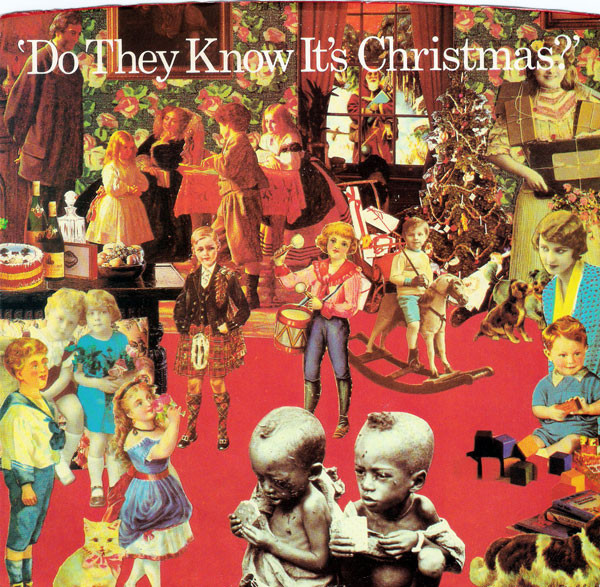
The irony was that the impetus for Live Aid could not have been more “New Wave.” Bob Geldof of New Wave faves The Boomtown Rats saw a harrowing BBC documentary on African Famine and resolved to do something about it on a personal level. Was there ever a more D.I.Y. response to a political and humanitarian disaster ever mounted than that of Band Aid?
He called up Midge Ure of Ultravox and they cooked up a benefit project called Band Aid which saw all of the top British charts acts of the time to do what they could to get food into the mouths of starving people. The modest charity record that they hoped would have a little impact raised over 24 million dollars and was a shot heard ’round the world.
Here is the roster of talent that took part in the single. We’ll sort the artists according to these three groupings: New Wave, Boomer Rock, and Pop/Soul.
| New Wave | Boomer Rock | Pop/Soul |
|---|---|---|
| Bono | Phil Collins | Robert “Kool” Bell |
| Boy George | Rick Parfitt | George Michael |
| Pete Briquette | Francis Rossi | James “J.T.” Taylor |
| Adam Clayton | Sting | Dennis Thomas |
| Chris Cross | Jody Watley | |
| Simon Crowe | Paul Young | |
| Sara Dallin | ||
| Siobhan Fahey | ||
| Johnnie Fingers | ||
| Bob Geldof | ||
| Glenn Gregory | ||
| Tony Hadley | ||
| John Keeble | ||
| Gary Kemp | ||
| Martin Kemp | ||
| Simon Le Bon | ||
| Marilyn | ||
| Jon Moss | ||
| Steve Norman | ||
| Nick Rhodes | ||
| John Taylor | ||
| Roger Taylor | ||
| Midge Ure | ||
| Martyn Ware | ||
| Paul Weller | ||
| Keren Woodward |
This sorting is arbitrary, and the lines are blurred, I’ll admit. Some of the “New Wave” acts here would mature into Boomer icons in short time. But for the most part, these were British bands of the moment with under a decade of history to their names, and most of them were forged in the flames of New Wave or Post-Punk. I would maintain that the list of talent is overwhelmingly so. There were a few older performers there, but I could argue that members of Status Quo, and Phil Collins were hardly actual Boomer icons like Robert Plant or Paul McCartney. It’s interesting that US R+B acts like Shalamar and Kool + The Gang were represented there! Possibly by virtue of their chart success and proximity at the time. In retrospect, it’s was very cool that black Americans were invited to the event but I feel that speaks to the inclusionary values of the people in charge.
All of these aspects tied the Band Aid record to the Post-Boomer generation of talent. Ironically, it was Boy George, who had the Culture Club stage at Wembley in the Christmas season of 1984 crashed by a few other singers who had also sang on the Band Aid record join him for an impromptu rendition of “Do They Know It’s Christmas?” and was so moved by it that he suggested to Bob Geldof that they should have a concert.
The logistics would be big. By now the world was aware of Band Aid and what they had achieved. With that notion the plans were begun for Live Aid, and every modesty that gave the Band Aid notion charm was jettisoned for grandiosity. With Live Aid, the music decided it was time to grow big or go home. One stadium was not enough. One continent was not enough. The event would test the engineering mettle of those tasked to dare to coordinate and sequence a transatlantic concert event on two stages with a combined live audience of over 160,000 and a television audience of over a billion.
It was all driven by the urgency of raising the most money possible to feed starving people. A noble goal. But in the rush to embrace values of size, I don’t think anyone realized what the implication was for music. Which had been reacting against the values of size that had led to Punk Rock a decade earlier. One the decision to “go as big as humanly possible” inhumanity is knocking on the front door, trying to enter.
“The show should be as big as is humanly possible.”
Bob Geldof [Melody Maker 1985]
When the day of Live Aid rolled around, I had already watched Oz For Africa, which MTV had broadcast highlights of in the wee hours of July 12th. By the time that Live Aid started in Wembley Stadium at 7 a.m. EDT I had MTV back on and was marginally interested in seeing Ultravox, one of my favorite bands, playing live at this event. A few other bands I liked were on the roster as well. I started watching but by the time Elvis Costello had his one song, two hours into it, I had enough of this dreadful event. MTV was showing maybe half of the band’s sets. I could not foresee wanting to subject myself to any more of this. And it must be said, in going big, the people in charge asserted that actual honest-to-goodness Boomer Icons would be given the climactic pedestal of the day’s schedule after almost a decade in the cultural wilderness. Here is the roster of Live Aid as it happened in London and Philadelphia that day, given the same sort of sorting.
| New Wave | Boomer Rock | Pop/Soul |
|---|---|---|
| The Style Council | Status Quo | Nik Kershaw |
| The Boomtown Rats | Sting | Paul Young |
| Adam Ant | Phil Collins | The Hooters |
| Ultravox | Bryan Ferry | Four Tops |
| Spandau Ballet | Dire Straits | Billy Ocean |
| Elvis Costello | Queen | Run-D.M.C. |
| Sade | David Bowie | Rick Springfield |
| Howard Jones | The Who | Bryan Adams |
| U2 | Elton John | Ashford & Simpson |
| Simple Minds | Freddie Mercury/Brian May | Madonna |
| Pretenders | Paul McCartney | Patti Labelle |
| The Cars | Joan Baez | Hall & Oates |
| The Power Station | Black Sabbath | |
| Thompson Twins | REO Speedwagon | |
| Duran Duran | Crosby, Stills & Nash | |
| The Beach Boys | ||
| George Thorogood + the Destroyers | ||
| Santana | ||
| Tom Petty & The Heartbreakers | ||
| Kenny Loggins | ||
| Neil Young | ||
| Eric Clapton | ||
| Led Zeppelin | ||
| Crosby, Stills, Nash & Young | ||
| Mick Jagger | ||
| Tina Turner | ||
| Bob Dylan | ||
| Keith Richards | ||
| Ronnie Wood |
And Judas Priest!
That’s almost a reversal of the values that had informed Band Aid with Boomers far outnumbering the young upstarts. Sure, sure. Apart from Status Quo [!] the “opening acts” of Like Aid UK were all the artists that I had any interest at all in seeing. The bands who had surfed the New Wave to chart success. And even so, the presentation in a huge stadium, was at odds with how I feel that Music is best enjoyed. On a more human scale. This was the necessary evil that boosted the event’s chances at making a life-or-death difference and the positive association of that fact seemed to end up in giving CPR to a lot of Rock corpses; left for dead on the slab.
Until today I had no earthly clue that both Crosby, Stills & Nash AND Crosby, Stills, Nash & Young had separate sets at JFK Stadium! Observe the megadeath firepower of Boomer Rock writ large. Live Aid managed to completely re-route the rivers of Rock Music in ways that re-established the Boomer Rock Hegemony waiting for one more chance to lord it over the rest of us with their presence. Which they are doing to their very graves with the complicity of an even more consolidated media structured that has a very small number of companies controlling the entire cultural storyline today.
Now that I think of it, Naomi Klein could have posited her Disaster Capitalism theorem by extrapolating the famine events in Africa that led to Baby Boomer Rock icons becoming more entrenched than ever following a temporary dalliance by Punk with an attempt to bring rock music back down to a more immediate social level as something closer to an exchange between peers rather than the transmissions from a remote and exclusive ruling class of Rock to the rabble. As David Rimmer has cogently put it, “Like Punk Never Happened.”
-30-





![Want List: Visage DLX RM […finally!]](https://i0.wp.com/postpunkmonk.com/wp-content/uploads/2018/11/visage-dlxrmuscda.jpeg?resize=200%2C200&ssl=1)


 Post-Punk Monk
What is interesting to me is who isn’t on the list…and you made a similar point to another article I read albeit from the opposite political perspective: Live Aid gave former ‘dying’ bands a boost and buried the burgeoning new music of the time. My memory is hazy, but I do have the ‘feelings’ in my memories of the music while I was in college (81-85) being the most memorable-it was different from what came before. 85 onward I leaned away from the music/dancing scene. Perhaps it was also due to the music scene changing again.
I’m in UK now-the background music in stores/on trains etc is of the genre from 78-85 post-punk….😀
LikeLike
Deserat – Right! The bands of Post-Punk who were graduating to stadium status at that time: think The Cure or Depeche Mode, were nowhere to be seen on either side of the Atlantic.
LikeLike
I think at least two things are going on here (probably much more)
Lots of those boomer bands are American – having a show at JFK meant you had a chance for US acts to be involved. The Band Aid single was a faster, more immediate thing and unless people were in London that night, they missed out.
By 1983-1984 labels had figured MTV out and were willing to pour money into videos (think of those Tom Petty videos or those Styx videos) and so they reasserted themselves. No US label exec was going to prioritize say the Style Council over a new Bob Dylan album, heaven forbid. But even in the UK the old power structure “righted the ship” after new wave/the new romantics had briefly upset the apple cart. Look at the success of Tina Turner (Martyn Ware I love ya! but…) or how effing huge late period Queen was in the UK.
I just think label execs on both sides of the pond breathed a sigh of relief that they would not have to deal with color hair or neon spandex (at least until New Metal hit) and could go back to pushing their drug of choice- boomer rock via splashy MTV videos
LikeLiked by 1 person
David Richards – Boom! Head of nail, meet the hammer! This was perhaps the point where the pendulum of the previous five to six years had begun to swing backward. All of this was seemingly magnified by the events of Live Aid. And the huge drop in the watchability of MTV was inversely proportional to the amount of US label participation and the increasingly large budgets of US artist videos. The days of getting a film student and $5000 to make your video were being buried under all of the Billy Joel videos where he hired Ultravox and Duran Duran director Russell Mulcahy. I remember when Joel shot the first all union video. Admirable for the industry itself, but the noise you heard was the sense of adventure that music video had for a few years being taken outside and shot in the head.
LikeLiked by 1 person
I’m reminded of an exchange between a letter writer and the editors of Trouser Press somewhere late in that wonderful publication’s existence (’83, maybe?) that stuck in my noggin all these years. In a published letter, some poor soul rather fatuously moaned about how all the cool bands he liked weren’t getting enough exposure or radio play. He went on to exclaim something along the lines of, “MTV was supposed to focus on all the cool new bands.”
To this, the TP editors had a concise reply: “You’re wrong about the reasons for MTV. Grow up.”
LikeLiked by 1 person
Big Mark – Hah!! I vividly recall that letter page response! Too true, my friend!
LikeLike
Interesting, however I wouldn’t say that Sting was Boomer Rock in 1985. He guested on Dire Straits’ “Money for Nothing”, but I’d say that The Police were very much New Wave, having formed in 1977.
LikeLiked by 1 person
It may have done, but time and place. Although I’m firmly based in electronics, you can’t go beyond Queen’s ‘performance – Magic. p33t3r – less said about those lyrics the better.
PPM – Timeline check – 40 decades ago? No wonder I’m feeling my age then :)
LikeLike
Roger – Alas, I’ve been a Queen Hater all of my life. Though 45 years later I now find merit in “Crazy Little Thing Called Love.”
LikeLike