
When I think back to 1981, I was listening to a lot of WPRK-FM. College radio from Rollins College; a tony private college in Winter Park, Florida that had much better programming than the offerings from the State University that I attended at that time. I don’t recall ever hearing even the name Savage Republic at the time but this live album was recorded at the Whiskey-A-Go-Go on the 30th of December, 1981. And there probably never was a less likely band to trod that stage.

Savage Republic: Africa Corps Live At The Whiskey-A-Go-Go 30th December, 1981 – US – CD [2022]
- First Assembly
- Next To Nothing
- Real Men
- Attempted Coup: Madagascar
- Exodus
- Machiinery
- Mobilization
- Kill The Fascists!
- The Ivory Coast
- When All Else Fails
The Whiskey-A-Go-Go is legendary in the Corpus of Rock for its place in the history of the Rock Hegemony. How this band of Art School dissidents got the gig was down to providence and their fourth billing on the event as opening act for The Middle Class; Mike Patton’s [not that Mike Patton] Punk band of the era. It was L.A. in late 1981. What, other than New Wave, Hardcore, and Hair Metal [just around the corner] was the city busy coughing up? As this document showed, the then-named Africa Corps [they would change their name to Savage Republic soon after this gig] were listening hard to the first few PiL albums. But significantly more than that.
As much as PiL were fusing Krautrock and Dub music, Savage Republic mated martial drumming with decidedly Lebanese-style double picking that showed that they had been listening to their Dick Dale albums. The opening instrumental was a piece not yet fully formed, but fashioned almost totally with surf-adjacent guitar sounds. And percussive, metallic drumming that sounded more a call to arms than an invitation to the dance. And then guitarist/bassist Jeff Long began vocalizing.
That really broke the spell for me as his extremely monochromatic shouting [I can’t call it singing] brought back all of the faceless, unmusical Hardcore I’d been bearing on WPRK-FM for the last half of 1981. I actually stopped the disc then and there but gave it another chance a little later. Fortunately, other songs had Philip Drucker on vocals. While Mr. Drucker was no songbird, at least he wasn’t sticking the boot in on the sort of hectoring delivery that put me off of 98% of L.A. Hardcore in 1981.
Elsewhere, happy little ditties like “Attempted Coup: Madagascar,” explored a portentous and doom-laden sound [heavy on the fuzztone bass] that was an outlier back in 1981 to an ugly political future that maybe only DEVO were anticipating back then, albeit with ironically cheerful music. The huge difference 43 years later is that we don’t need to look to Madagascar for attempted coups.
All of these songs were surprisingly short and succinct for all of their aspirations to the drone. The only song here that really explored in depth the kind of environment they were obviously interested in defining was the 6:02 “Exodus.” The clanging rhythm guitar juxtaposed against the fuzztone bass and metallic percussion dared to build tension without the slightest thought given to its release in a bid to attain a viable Krautrock vibe.
“Mobilization” showed the band at their most dynamic thus far, with the bass sweeping far and wide throughout the horizon of the song; its notes bending constantly as the rhythm guitar almost explored Link Wray styled “chicken” rhythm. When no one was singing, this band attained a fascinating melange of influences thrown without any regard to propriety into their stylistic stewpot. But when Jeff Long was at the mic, we had jaw-droppingly blunt statements like “Kill The Fascists!” It was as artless as a song could be with such a loaded title. Completely lacking in the robust wit that, say, Heaven 17 brought to the same theme. At the same time, it was almost exhilarating to think that this was emanating from a Southern California band in 1981 and not the danker corners of Leeds, England.
The penultimate instro “The Ivory Coast” was announced with an ironic “surf’s up” from the stage before giving us a powerful blend of off-kilter, industrial drumming and a trebel-charged lead guitar that was showing that Agent Orange weren’t the only ones in L.A. that year interested in pulling Surf Music into the 80s. The concluding “When All Else Fails” featured Philip Drucker and the group hit as close to the PiL mark as they would on this early release.
This was a partially vexing album. What the band were attempting in their own way was absolutely slotting into the 1981 space where Post-Punk still existed. And taking the genre off-road to investigate radically disparate musical threads while proffering a harsh and bleak political worldview; easily discernible even on the instrumental material. I was attracted to their vibe yet repelled each time that Jeff Long began shouting at the mic. The band attaining an unholy blend of Dick Dale, Einstürzende Neubauten, and Dez era Black Flag somehow along the way. Fortunately, there was enough there there to keep me coming back to resample these wares.

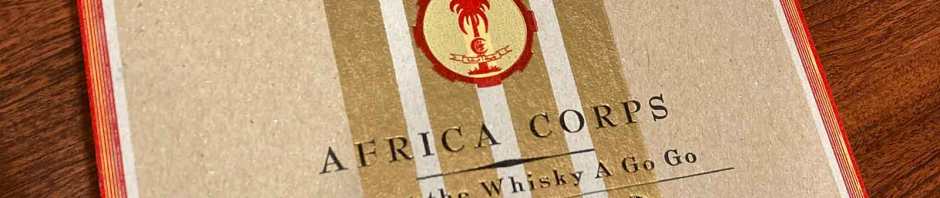
I had no such reticence with the frankly stunning package design that was down to the long-established house style of band member Bruce Licher’s Independent Project Records/Independent Project Press. I’d first run into Licher in the late 80s with Camper Van Beethoven’s use of their letterpress printing. When I saw that band in the late 80s in Downtown Orlando the merch table was selling a beautiful letterpress Camper Van Beethoven note card that I should still have around somewhere!
The CD was in a 6″ x 7″ chipboard folio rich with metallic gold inks with the silver disc in a custom printed wax paper envelope with folded liner notes and even four miniature facsimile flyers for the very gig captured on the disc itself. The splendid old school craft of it was actually at odds with the admittedly humorless tone of the music. The design seems pastoral when the music was the sound of tanks rolling into view.
But now that I know of Savage Republic, I’ve sampled their later, mature material and the latent promise that was hinted at here seemed to flower as the band continued to develop. Trading strident left wing militancy for a more melancholic vibe that didn’t drive me from the room even though I share their political opinions. Quite frankly, the disc is worth it on the design alone, with the label selling it for a modest $12.00. If you’re in the mood for a bracing cocktail of acids and base put into a shaker until they exploded, then DJ hit that button.

-30-




![2025 : The Year In Buying Music [part 2]](https://i0.wp.com/postpunkmonk.com/wp-content/uploads/2026/01/2025-buying-stats-1.jpg?fit=1200%2C620&ssl=1&resize=200%2C200)
![2025 : The Year In Buying Music [part 3]](https://i0.wp.com/postpunkmonk.com/wp-content/uploads/2025/10/steven-jones-fluid-japan-truthdl.jpg?resize=200%2C200&ssl=1)
![2025 : The Year In Buying Music [part 1]](https://i0.wp.com/postpunkmonk.com/wp-content/uploads/2026/01/2025-the-cull.jpg?fit=1200%2C900&ssl=1&resize=200%2C200)

 Post-Punk Monk
I love Savage Republic and Bruce Licher’s art. Their debut album “Tragic Figures” is for me one of the best American post-punk releases, so good that I have several copies across various formats. You might enjoy Bruce’s post-Savage Republic recordings as Scenic, quite Morricone-esque instrumentals. How did you happen upon this live CD?
LikeLike
Strange Idol – I can hear the Morricone lurking nearby. I cannot tell a lie: a West Coast Promo Man was involved. What I wonder is this: how did I miss this band 40 + years ago?
LikeLike
I first encountered Bruce Licher’s work on the cover art for “Music For 3 Pianos” by Harold Budd, Ruben Garcia & Daniel Lentz, and the Harold Budd compilation album “Fenceless Night: Selected Works For Cinema 1980-1998”. I don’t know if Bruce would remember, but we exchanged a couple of E-Mails where he told me about his (Scenic) album “The Acid Gospel Experience”. His mastery of letterpress is legendary.
LikeLike
Pingback: Dippping Into Contemporary Savage Republic Revealed A Band That Honored Their Artistic DNA While Buffing It To A Gleaming Gloss | Post-Punk Monk