
Believe it or not, Ye Olde Monk does not live by New Wave alone. If all I ever saw live in Orlando were concerts by New Wave acts, I might have maybe a few dozen concert experiences under my belt instead of hundreds. The acts I liked best [usually from the UK] played Central Florida last on their conquests of North America, if they ever played America at all. I had seen maybe 40 concerts in the 80s. By the 90s, I felt that something had to change, especially since New Wave had long since petered out by that time!
So I started dipping my toes into the local acts in Orlando by the early 90s in my search for kicks. I think the first local act I noticed when they were opening for a touring band was the Rockabilly act “Rocket 88.” That I can’t remember the national touring band that initially drew me out to Club Spacefish that night is testament to their prowess. So when following Rocket 88, they were my gateway drug to so many local acts that soon occupied most of my nights. Psycho From Texas, The Hate Bombs, Potential Frenzy soon formed my core of acts I would always see live.
The Hate Bombs were a nouveau Garage Punk band that started to form a local Garage Rock scene around their orbit. They soon brought in regional acts from further afield that they were in thrall to and could open up for. Other thrill-packed bands such as The Woggles, The Cowslingers, and The Fleshtones.
In the absence of the arty Post-Punk that was my main taste, but largely absent in the music scene of the time, I managed to cultivate and slake a thirst for the Garage Rock that was always a spiritual precursor to Punk. After all, when Lenny Kaye compiled the original “Nuggets” compilation in 1972, what he first called “Punk Rock” on that album became a flashpoint for not only defining what Garage Rock had been, but what it would inspire going forward.
I already had fond memories of the pre-psychedelic sounds of Los Angeles radio that I had heard as a young boy. My first favorite song I can remember having [before third grade] was ? + The Mysterians’ crucial “96 Tears.” When New Wave happened in the late 70s, I could already see a through line from songs like that or The Seeds “Pushin’ Too Hard” to both Punk Rock and the New Wave that followed quickly in its wake.
In the ensuing decades following “Nuggets” and the long shadow that it cast there have been no shortage of hypstrz digging for ever more obscure self-released 45s from the mid-60s and re-issuing them for eager modern ears. From the best minds at the Sundazed/Modern Harmonic/Yep Roc axis from our own region came a new release over my transom that was as hyperlocal as it can get! The Beat Rocket label [a subsidiary of Sundazed] has managed to find an album’s worth of material from The Satyrs; a Garage Band from Asheville, North Carolina full of sessions that the band recorded in the region when they were the kings of the local Teen Scene.

Back in ’65, they managed a single 45 of “Blue Blue World” b/w “Don’t Be Surprised” that appeared on as the only release on the local Wal-Mor label. The group had barely recorded a handful of songs and only released two when their time came to an end when the band’s teenage years ended coincidental to the rise of the Vietnam War. Singer/guitarist Jeff Phillips was the oldest so he cut to the chase and enlisted in the Coast Guard to avoid “winning” the Draft lottery. The band fizzled out and were forgotten until Rock Archaeologists came sniffing around their former environs decades later. And now we have a ten track album of The Satyrs nearly 50 years later.
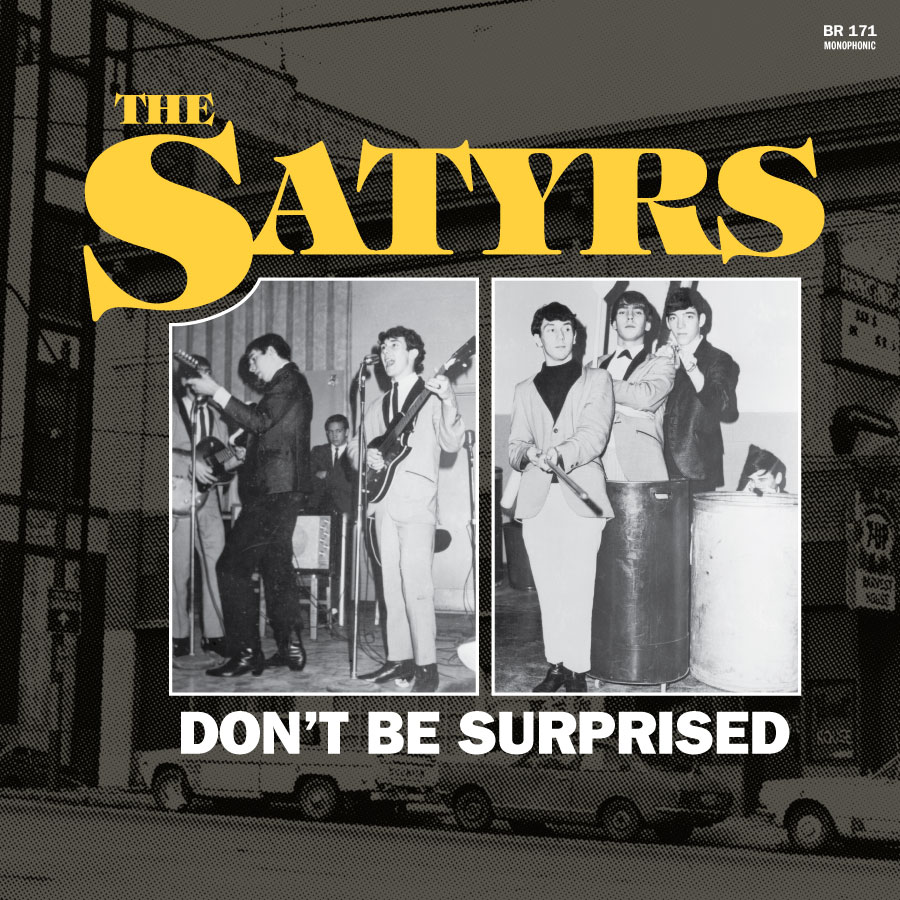
The Satyrs: Don’t Be Surprised – US – yellow LP [2023]
- Don’t Be Surprised [alt. ver.]
- Get Out Of That Rut
- It Won’t Be Long
- Ticky Tacky
- Try Not To Cry
- To Be With You
- I Walk The Line
- The Shortest Road To You
- Blue Blue World
- Don’t Be Surprised
The album opened with a later re-recording of “Don’t Be Surprised” that re-cast their song from the original 45 in a slicker, poppier light. Heavy on the treble twang. One can definitely hear this take becoming a regional hit at the very least as the band managed to invest the minor key gem with some of the same sauce that The Beau Brummels were riding into the charts.
The languid soul strut of “Get Out Of That Rut” managed to rope in a little Ricky Nelson vibe on the singing. The band also assayed a little of the then exploding sound of The Byrds with the 12-string and tambourine jangle of “It Won’t Be Long.” The band were capable of dipping their toes in the varied musical fashions of the day with ease.
The biggest song here that would have been a shoo-in for inclusion on “Nuggets” was definitely “Ticky Tacky.” It was a song where the cat in heat harmonica and the vocalist leaned heavily into some of the same Jagger raunch that had informed “Get Off Of My Cloud” at much the same time as this recording was made. For me the essence of Garage Rock was in the would-be Jaggers of every small town in America who were desperate to revel in the same attitudes as their rebellious heroes. I can also hear echoes of the ne plus ultra of Garage Rock here as well; the primal grunt that was The Kingsmen’s “Louie Louie.” Dig it.
“To Be With You” moved in the opposite direction with some serious baritone crooning right out of the Righteous Brothers playbook, but the minor key electric organ drone running through the song added something more haunting and uncanny to the results.
If you’ve ever looked at rock albums from the 60s it’s hard not to notice that prior to … let’s say “Sgt. Pepper’s Lonely Hearts Club Band,” most of the songs on a “rock album” might be cover tunes. In that respect, it’s a little shocking that the only cover on “Don’t Be Surprised” was Johnny Cash’s classic “I Walk The Line,” but The Satyrs made it well worth our time with a radical upbeat, rock and roll arrangement that bore little resemblance to your memories of the song. This was probably one of their live set pieces that they wisely committed to tape.
The ten tracks here closed with both sides of the the original 45 that, until now, was all the world had ever heard from The Satyrs. It was recorded in a night time session in a local hi-fi store straight to tape with no overdubbing. The A-side was “Blue Blue World,” which trafficked in the sort of laid back, jazzy vibes of Classic’s IV’s hit “Spooky.” Which was a very neat trick since that song would not be recorded for another three years, but the lyric couldn’t help but make me think of early Chris Isaak. Even though singer Jeff Phillips was projecting a lot more than Isaak would in another generation where licking your romantic wounds would be more of a James Dean than Jack Jones thing.
The original 45 version of “Don’t Be Surprised” was more primal and urgent than the take that opened the album. Vocalist Bucky Hanks sounded more yearning than confident here though the singer and band got a little out of control on the caterwauling middle eight. Hanks obviously went off-mic so your guess is as good as mine as to what he’s imparting there, but here’s a helpful video, chock full of vintage Asheville sights from the exact era. A lot of those views are still here, just with hotels jammed into every nook and cranny.
EVEN MORE LOCAL

The Beat Rocket yellow vinyl LP is twice as Ashevillian as the album itself, due to the incredibly proper decision to have the clear yellow vinyl disc pressed locally at Asheville’s Citizen Vinyl pressing plant [and taproom]. I have to say that even though I had access to a promo download, I made the effort to listen to and digitize the LP that they sent me, since I wanted to see how Citizen Vinyl measured up to the state of modern wax. The end result was at least a B+ for fidelity with the mono disc only exhibiting a few pops on the B-side of the disc. A far cry from the worst modern record I’ve heard and a very honorable colored vinyl 140 g pressing.
After several spins of “Don’t Be Surprised” I was struck by how these teenagers from two generations ago managed to cut a sharp figure with all of these songs they had written and recorded even before graduating high school. It’s very eclectic, as they were trying on various musical personae, and managing to do it with great success. There’s nothing in the way of filler here. If you can enjoy retro music that aims further back than 45 years, The Satyrs were well worth the time spent enjoying this disc that miraculously appeared nearly 50 years later. Beat Rocket release “Don’t Be Surprised” on September 8th, on the silver disc for $16.99 and the yellow disc for $26.99. In a rare move, I will go on record as saying that the locally recorded and pressed LP is the ideal way to go. And since it’s in pre-order until Friday, there are $2.00 discounts on the Modern Harmonic website. Be there or be square.
CD

YELLOW VINYL LP
-30-




![2025 : The Year In Buying Music [part 2]](https://i0.wp.com/postpunkmonk.com/wp-content/uploads/2026/01/2025-buying-stats-1.jpg?fit=1200%2C620&ssl=1&resize=200%2C200)
![2025 : The Year In Buying Music [part 3]](https://i0.wp.com/postpunkmonk.com/wp-content/uploads/2025/10/steven-jones-fluid-japan-truthdl.jpg?resize=200%2C200&ssl=1)
![2025 : The Year In Buying Music [part 1]](https://i0.wp.com/postpunkmonk.com/wp-content/uploads/2026/01/2025-the-cull.jpg?fit=1200%2C900&ssl=1&resize=200%2C200)

 Post-Punk Monk
Pingback: 2023: The Year In Buying Music [part 4] | Post-Punk Monk